API keys authenticate your backend — either to submit on someone’s behalf without CAPTCHA, or to read data through the Server Data API. They’re managed from your workspace’s API Keys settings.
A key requires the Starter plan or above. Never expose a key in client-side code, a public repo, or a mobile app bundle — anything with submit scope can create submissions, and anything with read/admin scope can read or delete your data.
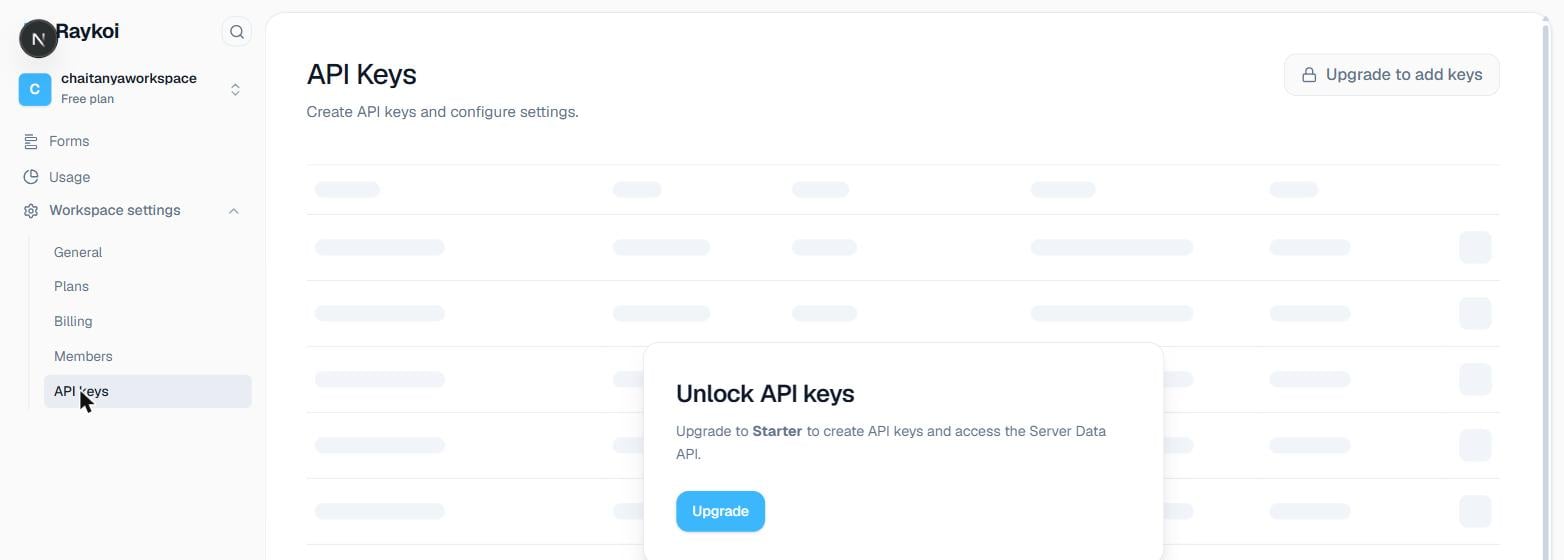
API Keys page on a Free-plan workspace, showing the Starter-plan upgrade gate

Creating a key

1

Name it

Something that identifies where it’s used — production-backend, zapier-integration — since you’ll see this name (not the key itself) everywhere the key is referenced later.
2

Choose a type

live (rk_live_...) for production, test (rk_test_...) for anything you don’t want mixed into real data.
3

Choose scopes

scope
Authenticates a submission, skipping the CAPTCHA gate. Included by default.
scope
Read access to the Server Data API — forms, submissions, analytics, file download URLs. Included by default.
scope
Everything read grants, plus deleting submissions. Not included by default — add it deliberately.
4

Copy the key immediately

The raw key is shown exactly once, at creation. Only its prefix (rk_live_ab12...) is ever shown again — if you lose the full value, revoke it and create a new one rather than trying to recover it.

Using it

Same header everywhere the key is accepted — submitting, or reading through the Server Data API:
An invalid or revoked key returns 401:
401

Revoking a key

Immediate — a revoked key stops authenticating on its very next request in most cases. There’s a short window (client-side caching, up to ~30 seconds) where a request already in flight on a different server instance might still succeed, but nothing new authenticates after that.

Key limits

Your plan caps how many active keys you can have at once. Downgrading a plan never revokes existing keys — it only blocks creating new ones past the new, lower limit. If you’re over the limit after a downgrade, your oldest keys (first created) stay counted as within-limit; anything newer is flagged as over-limit in the dashboard, though still functional until you revoke down to the new cap.